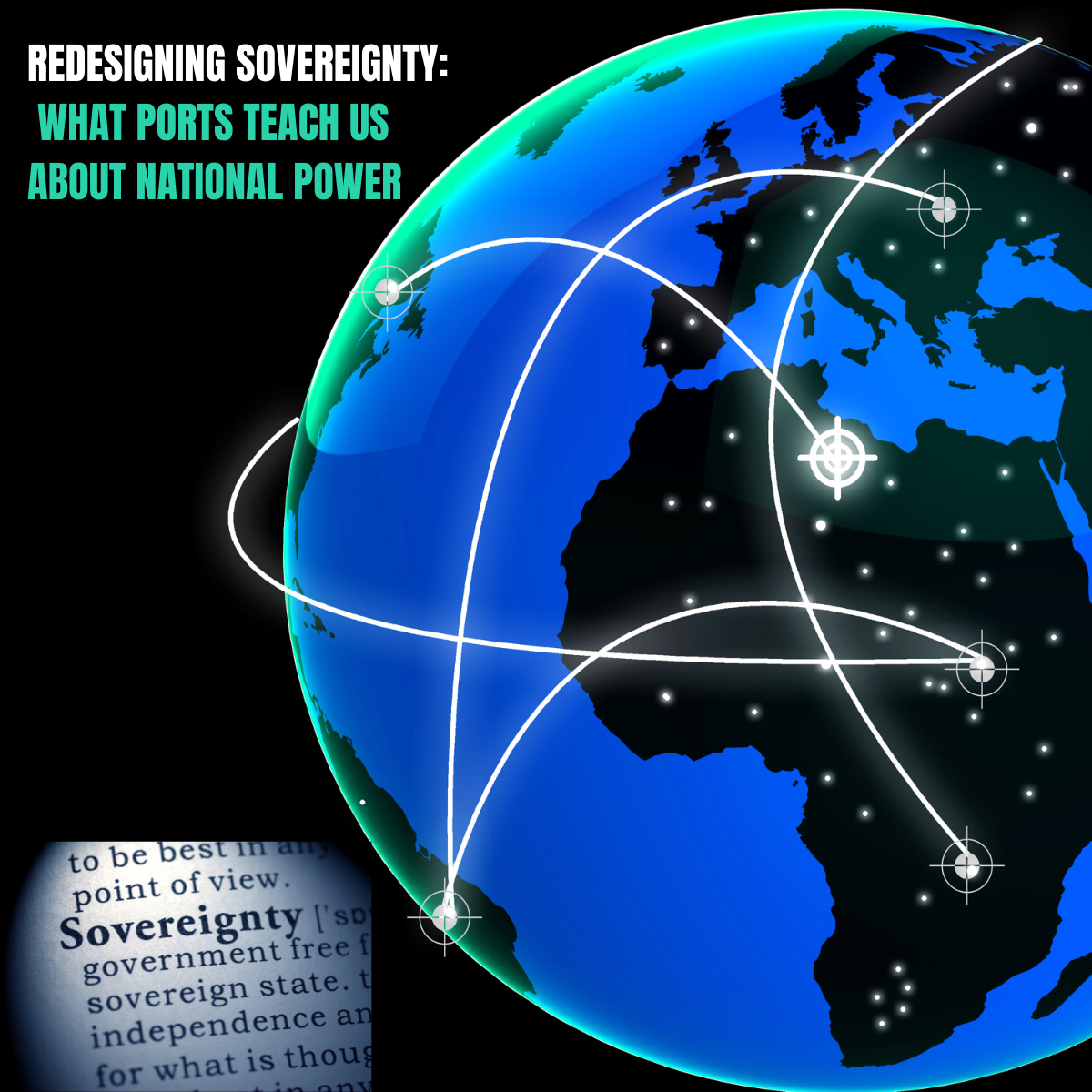
Everyone’s looking at the same pieces. Almost no one is seeing the board.
Autonomous shipping. Energy infrastructure. Defense industrial capacity. Port modernization. AI at sea. If you work in maritime, infrastructure, or energy, you’ve been in conversations about at least one of these in the past months.
Most people are tracking these as separate trends. They’re not. They’re one system finally becoming visible.
The signals are everywhere
Last week, South Korea launched the M.AX Alliance — 50 organizations spanning shipbuilding, shipping, and AI. The explicit goal: accelerate autonomous vessel deployment by treating it as a national industrial priority, not a technology experiment.
What makes M.AX different: it’s not another research program. It’s an execution structure. Shipbuilders, shipping companies, Naver, KT, universities, government ministries — all at the same table, with shared data standards and demonstration projects launching this year.
Meanwhile, IMO finalized nearly all chapters of the MASS Code in 2025. Norway approved unsupervised commercial operations for unmanned surface vessels. The U.S. National Security Strategy now explicitly names maritime infrastructure and shipbuilding capacity as pillars of economic security. And MARAD just appointed Stephen Carmel — a former Maersk executive with operational, financial, and national security credentials — as Administrator. The people being put in position aren’t bureaucrats. They’re operators.
Ports are becoming technology infrastructure, not just cargo infrastructure. The Port of Tyne is testing 6G with BT to become a connectivity hub. Amazon Kuiper is launching this year to compete with Starlink for maritime communications.
The lines between maritime, energy, and tech infrastructure are disappearing.
The question isn’t whether these sectors will transform. It’s who will connect them — and control the system that emerges.
The convergence underneath
Here’s what I kept seeing in December, across conversations that were supposed to be unrelated:
Family offices weren’t just looking at random assets. They were asking about energy supply to those assets — grid capacity, floating power solutions, the infrastructure underneath the infrastructure.
Defense conversations kept circling back to commercial shipbuilding. Build all the Navy vessels you want — but without a healthy commercial shipbuilding base and supply chain underneath, you can’t surge when it matters.
Autonomous shipping discussions weren’t just about technology. They were about regulatory fragmentation, insurance gaps, and workforce transition — the stuff that actually determines whether a pilot becomes a fleet.
Energy security conversations weren’t separate from maritime conversations. They were the same conversation — because floating assets, offshore infrastructure, and port-side power are all part of one physical system.
Why this matters for operators and investors
Speed right now isn’t about capital. It’s about whether you’re still managing these as separate initiatives or treating them as one system.
South Korea isn’t ahead because of money. They’re ahead because they built a coordination mechanism that connects shipyards to AI companies to shipping operators to government — and gave them a shared objective.
The U.S. has more capital, more technology, and more talent. What it lacks is the connective tissue. The National Security Strategy names the priorities. The SHIPS Act provides a legislative framework. But translating policy into execution requires something that government alone cannot provide: industry coordination across traditional boundaries.
That’s the gap — and it’s also the opportunity. The NSS sets direction. The SHIPS Act provides authority. What’s missing is the coordination layer that translates policy into execution. Whoever builds that connective tissue — across industry, government, and capital — will shape what actually gets built.
The patterns that will define 2026
Who builds coalitions — not just who announces initiatives.
Whether the energy conversation and the maritime conversation finally merge. They’re already the same infrastructure problem.
Which regulatory frameworks actually enable deployment — autonomous vessels, floating energy infrastructure, port-side power. The technology exists. The question is who creates the pathway from pilot to scale.
Ports becoming technology infrastructure, not just cargo infrastructure — like the Port of Tyne testing 6G with BT to become a connectivity hub, or Amazon Kuiper launching this year to compete with Starlink for maritime communications.
And who’s positioning for the system — not just reacting to the headlines.
The geopolitical noise will be loud in 2026. But the real moves will be structural.
Convergence isn’t chaos. It’s a reset.
The operators who see it will shape what gets built.
What convergence are you seeing? What’s connecting that didn’t used to?
—Beatriz
Comments are closed